
Best Lead Generation Tools for B2B Sales in 2026
The ultimate guide to B2B lead generation tools in 2026. From prospecting to enrichment, find the right tools to build pipeline and close deals faster.
Jesse Ouellette
February 18, 2026
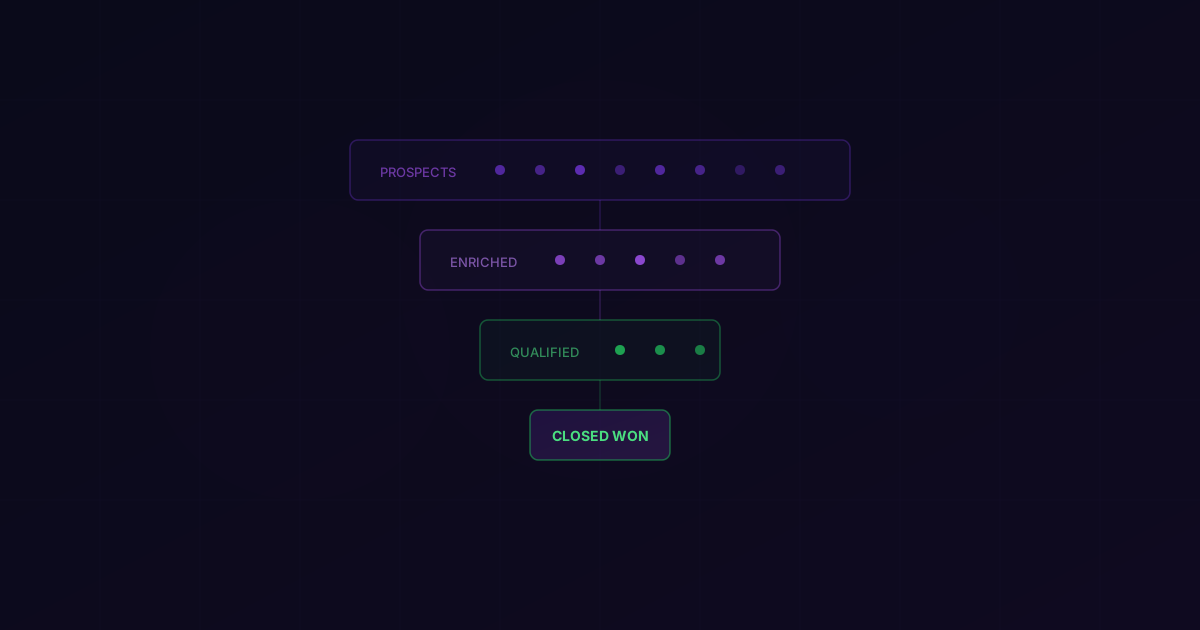
I've been building outbound sales systems for over a decade now, and I'll say this bluntly: the lead generation landscape in 2026 looks nothing like it did even two years ago. Half the tools people were swearing by in 2024 are either dead, acquired, or so bloated with features that nobody can figure out what they actually do anymore.
Here's the thing. The era of blasting 10,000 cold emails from a single tool and hoping for replies is over. Google and Microsoft clamped down hard on bulk sending. Prospects are drowning in AI-generated outreach that all sounds the same. And the tools that used to be "good enough" are now actively hurting your pipeline because the data they're built on has rotted.
So what works now? A focused stack of specialized tools, each doing one thing exceptionally well, connected by automation. Quality over quantity isn't a cliché anymore—it's a survival strategy.
I wrote this guide because my team at LeadMagic talks to hundreds of sales leaders every month, and the number one question we hear is: "What tools should I actually be using?" This is my honest answer.
What Makes a Good Lead Generation Tool in 2026?
Before I walk through specific tools, let's talk about what actually matters when you're evaluating a lead gen tool this year. The criteria have shifted significantly.
Data Accuracy
This is non-negotiable. If you're still accepting 80% email accuracy from your data provider, you're burning your domain reputation and your TAM simultaneously. I wrote an entire post about why data accuracy is the only metric that matters. The short version: anything below 95% is a liability. We hold ourselves to 97% at LeadMagic because that's where the noise disappears and you can actually scale with confidence.
Coverage and Depth
A tool that gives you a name and email is table stakes. In 2026, you need the full picture—mobile numbers, job change history, company technographics, funding data, hiring signals. The more context you have before hitting "send," the better your conversion rates will be.
Pricing Model
Annual contracts with seat-based pricing made sense when these tools were scarce. They don't make sense anymore. Pay-per-result models align the incentive: the provider only gets paid when they deliver value. If a vendor is locking you into a $15K/year contract, ask yourself what they're optimizing for—your results, or their revenue predictability.
Integration Ecosystem
No tool exists in a vacuum. Your lead gen tool needs to plug into your CRM, your outreach platform, your enrichment layer, and your automation engine. If it doesn't have native integrations or a solid API, it's going to create more manual work than it saves.
Speed
Real-time enrichment beats stale databases every time. B2B data decays at roughly 3% per month. By the time a static database updates its records, a meaningful percentage of your leads have changed jobs, gotten promoted, or left the company entirely. The best tools in 2026 validate and enrich at the point of use.
Best B2B Lead Generation Tools in 2026
I'm breaking these into categories because the biggest mistake teams make is trying to find one tool that does everything. That tool doesn't exist. The teams closing the most deals are running a purpose-built stack.
Data Enrichment & Contact Finding
This is the foundation of your entire outbound engine. Get this wrong, and nothing else matters.
LeadMagic
I'm biased, obviously—I built it. But I built it because I was frustrated with everything else on the market, and the results speak for themselves.
LeadMagic delivers 97% email accuracy with a pay-per-result model. No annual contracts. No seat limits. Credits roll over on Essential plans and above. We run 18+ enrichment APIs covering everything from email finding and mobile numbers to company enrichment and profile search.
The Lead Finder is where most teams start—give us a LinkedIn URL or a domain, and we'll give you verified contact data in seconds. Not guesses. Not "confidence scores." Verified, deliverable results.
Where LeadMagic really shines is in waterfall enrichment workflows. We're natively integrated with Clay, so you can set us up as your primary enrichment layer and only fall back to secondary providers when needed. This means you get the best accuracy at the lowest cost, automatically.
Best for: Teams that need accurate contact data at scale without overpaying. SDR teams, agencies, and ops teams building enrichment workflows.
Pricing: Pay-per-result, with plans from $59.99/mo. No per-seat fees, no annual lock-in.
Apollo.io
Apollo is the Swiss Army knife of the lead gen world. They've got a prospecting database, email sequences, a dialer, and basic enrichment all in one platform. Their database is genuinely large—260M+ contacts at last count.
The trade-off is accuracy. In independent tests, Apollo's email accuracy hovers around 85%. That's fine if you're doing low-volume, highly targeted outreach. But if you're trying to scale, that 15% miss rate will compound fast—bounced emails, wasted sequences, and a sender reputation that slowly bleeds out.
Apollo's also shifted to a more aggressive seat-based pricing model in the past year. The free tier is still generous for getting started, but once you need team features and higher volume, the costs add up.
Best for: Early-stage teams that want everything in one platform and aren't yet at a scale where data accuracy becomes a bottleneck.
Pricing: Free tier available. Paid plans start at $49/user/month.
ZoomInfo
ZoomInfo is still the 800-pound gorilla in the B2B data space. They have the deepest dataset, the best intent signals, and the most enterprise features. If you're a publicly traded company with a 50-person BDR team, ZoomInfo probably makes sense.
For everyone else? It's hard to justify the price. ZoomInfo contracts typically start at $15K/year and quickly climb to $30K-$50K+ once you add the modules you actually need. And despite the premium pricing, data accuracy isn't dramatically better than cheaper alternatives—independent audits put it around 88-92%.
Their acquisition strategy has also made the platform feel bloated. They've bolted on conversation intelligence, form capture, website visitor tracking, and a dozen other features that most teams don't use.
Best for: Enterprise sales teams with dedicated ops resources and the budget to justify a premium data platform.
Pricing: Starting at ~$15K/year. Custom enterprise pricing.
Sales Engagement & Outreach
Once you have verified contact data, you need a way to reach out. These tools handle the delivery side.
Instantly
Instantly has quickly become the go-to cold email platform, and for good reason. They've built the best email deliverability infrastructure in the market. Automated warm-up, inbox rotation across unlimited sending accounts, and a smart sending engine that adjusts volume based on your reputation scores.
The platform itself is clean and focused. It doesn't try to be a CRM or a data provider. It does one thing—cold email at scale—and it does it better than almost anyone.
Best for: Teams doing high-volume outbound who need to protect deliverability above all else.
Pricing: Starting at $30/month for the Growth plan.
Smartlead
Smartlead occupies a similar space to Instantly but leans harder into the agency use case. If you're managing outbound for multiple clients, Smartlead's multi-client management, white-labeling, and inbox rotation across hundreds of accounts make it a strong choice.
They've also built out multi-channel features—LinkedIn touches, SMS, and calls alongside email—though the email engine is still the core strength.
Best for: Agencies running outbound campaigns for multiple clients simultaneously.
Pricing: Starting at $39/month. Agency plans available.
Lemlist
Lemlist was one of the first tools to push creative personalization in cold outreach—custom images, personalized video thumbnails, and dynamic landing pages. In a world where every inbox is full of generic AI-generated emails, that kind of creative differentiation still stands out.
The platform has evolved significantly, adding multi-channel sequences and a built-in B2B database. The database is decent for European contacts, though accuracy lags behind dedicated enrichment tools.
Best for: Teams that want to differentiate through creative, visually engaging sequences rather than pure volume.
Pricing: Starting at $39/month per seat.
Workflow & Automation
This is where the magic happens. The teams that win in 2026 aren't the ones with the best individual tools—they're the ones with the best-connected systems.
Clay
If you're not using Clay yet, you're probably doing too much manual work. Clay is a data enrichment orchestration layer that connects to 100+ data providers and lets you build waterfall enrichment workflows visually.
The concept is simple but powerful: instead of relying on a single data provider, you query multiple providers in sequence, using each one to fill gaps the previous one missed. LeadMagic is natively integrated as a Clay enrichment provider, and our data consistently ranks at the top of Clay's accuracy benchmarks.
Clay's learning curve is real—it takes time to build out effective workflows. But once you've dialed in your enrichment tables, the efficiency gains are enormous.
Best for: Revenue ops teams and growth engineers building sophisticated enrichment and scoring workflows.
Pricing: Free tier available. Paid plans start at $149/month.
n8n
n8n is the open-source alternative to Zapier, and it's become incredibly popular with technical teams building custom lead gen automation. Self-hosted, no per-execution pricing, and a visual workflow builder that can connect to virtually any API.
For lead generation, n8n is great for building custom flows: scraping LinkedIn profiles, enriching them through the LeadMagic API, scoring them with your own logic, and pushing qualified leads directly into your CRM or outreach tool.
Best for: Developers and technical teams that want full control over their automation without per-execution costs.
Pricing: Free (self-hosted). Cloud plans start at €20/month.
Prospecting & List Building
Before you can enrich and reach out, you need to find the right accounts and people to target.
LinkedIn Sales Navigator
Sales Navigator remains the gold standard for account-based prospecting. The search filters are unmatched—you can slice LinkedIn's 1B+ member database by seniority, function, company size, growth rate, technology used, and dozens of other criteria.
The limitation is what it always has been: LinkedIn aggressively rate-limits how much data you can extract. You can build beautiful lists inside Sales Nav, but getting that data out and into your enrichment workflow requires a separate tool (which is where LeadMagic's profile search comes in).
Best for: Any B2B team doing account-based prospecting. It's essentially a mandatory tool at this point.
Pricing: Starting at $99/month.
Phantombuster
Phantombuster automates LinkedIn actions—profile views, connection requests, data extraction, and message sequences. It's powerful and flexible, with pre-built "phantoms" for dozens of use cases.
The elephant in the room is compliance. Automating LinkedIn interactions technically violates LinkedIn's Terms of Service. LinkedIn has gotten significantly more aggressive about detecting and restricting automated accounts. If you go this route, use it carefully and with conservative limits.
Best for: Growth teams willing to accept some compliance risk for high-leverage LinkedIn automation.
Pricing: Starting at $69/month.
How to Build a Modern Lead Generation Stack
The tools above are ingredients. Here's the recipe—the stack architecture I'd recommend for a B2B team doing outbound in 2026.
Layer 1: Prospecting
Start with LinkedIn Sales Navigator to identify target accounts and contacts. Build your lists based on ICP criteria—seniority, function, company size, industry. Supplement with LeadMagic Profile Search to find contacts at specific companies that Sales Nav might miss.
Layer 2: Enrichment
Push your prospect lists into Clay and build a waterfall enrichment workflow. Set LeadMagic as your primary enrichment provider for email finding, mobile numbers, and company data. LeadMagic's 97% accuracy means fewer fallback calls to secondary providers, which keeps costs low and data quality high.
This is where most teams leave money on the table. If you're enriching with a single provider, you're accepting whatever gaps they have in their data. A waterfall approach with LeadMagic as the first layer gives you the best accuracy-to-cost ratio.
Layer 3: Outreach
Feed your enriched, verified leads into Instantly or Smartlead for email sequences. The key here is that your deliverability starts with clean data—if you've done Layer 2 right, your bounce rates should be under 1%, which keeps your sender reputation healthy and your emails landing in the primary inbox.
Layer 4: CRM
Everything flows back to HubSpot or Salesforce. Use your CRM as the system of record—every contact, every touchpoint, every stage change. The enrichment data from Layer 2 should sync directly into your CRM records so your AEs have full context before every call.
The Result
This four-layer stack gives you: precise targeting (Layer 1), verified data (Layer 2), reliable delivery (Layer 3), and a single source of truth (Layer 4). Each tool does one thing well, and the integrations between them eliminate manual work.
Comparison Table
Here's a side-by-side look at the top tools across the key criteria:
| Tool | Category | Best For | Pricing | Data Accuracy | Key Feature |
|---|---|---|---|---|---|
| LeadMagic | Enrichment | Accurate data at scale | Pay-per-result | 97% | 18+ real-time enrichment APIs |
| Apollo.io | All-in-One | Early-stage teams | $49/user/month | ~85% | Prospecting + sequences in one |
| ZoomInfo | Enterprise Data | Large sales teams | $15K+/year | ~90% | Intent signals + deep dataset |
| Clay | Workflow | Rev ops teams | $149/month | Varies by provider | Waterfall enrichment orchestration |
| Instantly | Outreach | High-volume outbound | $30/month | N/A | Best-in-class deliverability |
Lead Generation Trends for 2026
The landscape is evolving fast. Here's what I'm watching—and building for—this year.
AI-Powered Prospecting Is Getting Real
The AI hype of 2024-2025 produced a lot of noise and not much signal. That's changing. We're seeing AI tools that can genuinely identify high-intent prospects by analyzing job postings, funding announcements, technology installations, and hiring patterns. The teams that learn to leverage these signals will out-prospect everyone still relying on static lists.
Intent Data Is Becoming Table Stakes
Knowing who to reach out to is only half the battle. Knowing when to reach out is what separates good from great. Intent signals—website visits, content consumption, job changes, technology evaluations—are becoming core to every serious outbound motion. This is why we built Job Change Detection into LeadMagic. When a prospect changes roles, there's a narrow window where they're most receptive. Catch it.
Compliance-First Is No Longer Optional
GDPR was the opening act. With new privacy regulations rolling out across the US and APAC, the tools that survive will be the ones built with compliance at the core—not bolted on as an afterthought. This means consent-aware data sourcing, proper data handling, and transparent processing. If your data provider can't tell you where their data comes from, that's a red flag.
Quality Over Quantity Is Now Enforced by the Platforms
Google's sender reputation algorithms and Microsoft's Defender filters have made high-volume, low-quality outbound functionally impossible. Sending 1,000 mediocre emails will now actively damage your ability to send the 50 emails that matter. The winning teams in 2026 are sending fewer, better emails to more precisely targeted prospects—and they need data they can trust to do it.
Multi-Channel Is the Default
Email alone doesn't cut it anymore. The best teams are orchestrating sequences across email, LinkedIn, phone, and even direct mail. This makes data breadth critical—you need verified emails and mobile numbers and LinkedIn profiles for every prospect, not just one channel.
Bottom Line
The B2B lead generation tool landscape in 2026 is more fragmented than ever, but that's actually a good thing. It means you can build a stack that's precisely tuned to your motion instead of being forced into a one-size-fits-all platform that does everything "okay" and nothing great.
The foundation of any effective stack is data accuracy. If your contact data is wrong, your sequences don't matter, your personalization doesn't matter, and your "AI-powered" anything doesn't matter. You're just automating waste.
That's why we built LeadMagic the way we did—pay-per-result, 97% accuracy, 18+ enrichment APIs that cover everything from email finding to company enrichment. We wanted to be the foundation that the rest of your stack could trust.
Ready to see what accurate data actually looks like? Start with Lead Finder—give us a LinkedIn URL, and we'll show you verified contact data in seconds. No contract required. Your first credits are on us.